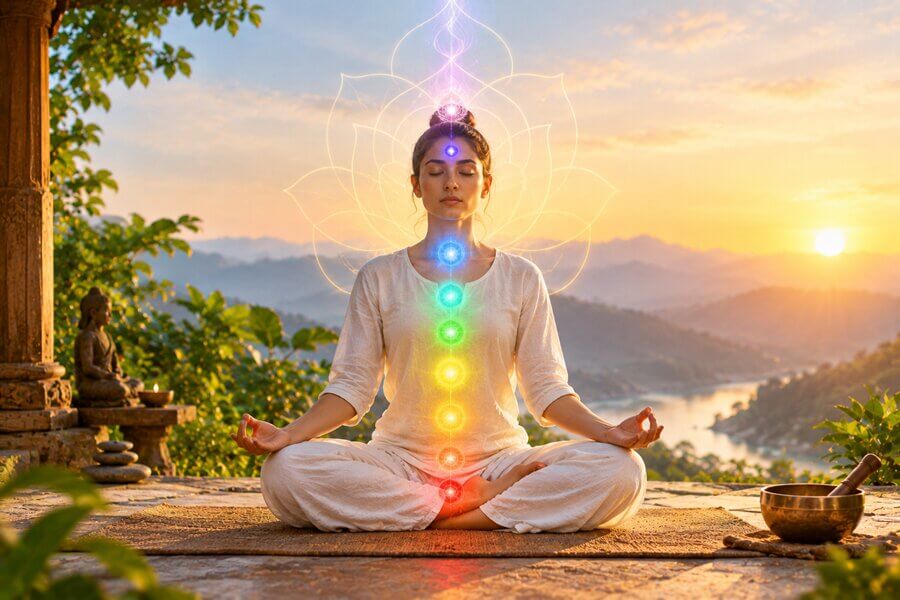
Yoga and Meditation: Are They Different?
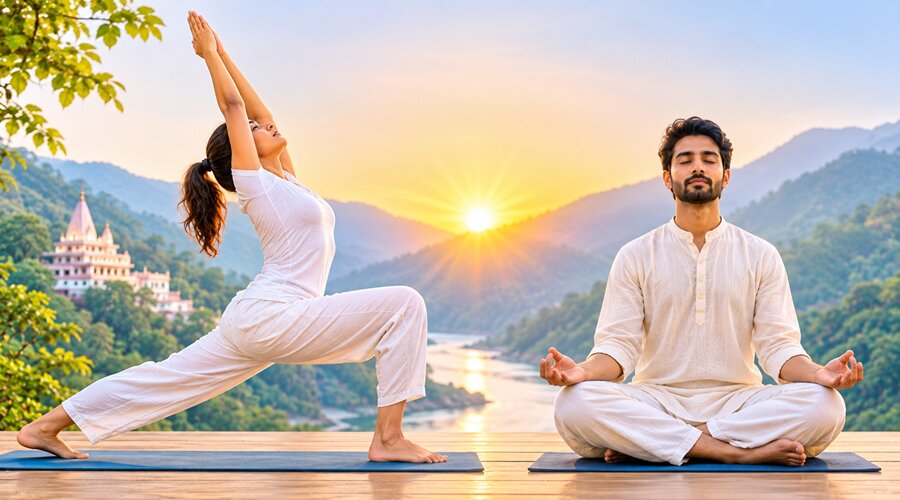
If meditation is part of Yoga, why do we often speak of them as two different things?
We hear people say, “I practise Yoga in the morning and meditate in the evening.” Others attend Yoga classes for physical fitness and separate meditation sessions for mental peace. Over time, Yoga and meditation have come to be understood as two distinct activities, each with its own purpose.
But is this distinction as clear as it appears?
To explore the question, we must look beyond how these practices are organised today and examine what each term actually points towards.
Yoga Is More Than a Practice
Yoga is often associated with physical postures, breathing exercises and flexibility. Meditation, on the other hand, is commonly associated with sitting quietly, closing the eyes and observing the mind.
This distinction is understandable but it can also limit our understanding.
In Patanjali’s Yog-sutra, the eight limbs form a framework that includes ethical principles, personal disciplines, posture, breath regulation, withdrawal of the senses, concentration, meditation and Samadhi.
Dhyana, usually translated as meditation, is the seventh limb. It is therefore not presented as something entirely separate from Yoga but as an integral part of its broader framework.
This gives us an important starting point, meditation can be understood as part of Yoga but Yoga cannot be reduced to meditation alone.
What Happens When We Meditate?
Let us look at a simple example.
You sit quietly and bring your attention to your breath. Within moments, a thought appears. You remember a conversation, anticipate a future event or become distracted by a sound. You notice the distraction and return your attention to the breath.
This happens repeatedly.
At first, you may think meditation means preventing thoughts from arising. But thoughts are part of the mind’s activity. Simply trying to suppress them may create another struggle.
What if meditation is not about forcing the mind to become blank but about understanding the movement of attention?
You begin to notice how thoughts arise, how emotions influence them, how desires pull attention elsewhere and how reactions develop. The breath remains an anchor but the mind itself becomes an object of investigation.
The practice then offers more than temporary quietness. It provides an opportunity to understand what happens within us.
From Concentration to Meditation
Patanjali distinguishes between Dharana, Dhyana and Samadhi.
Dharana refers to concentration, directing attention towards a chosen object.
Dhyana refers to meditation, the continuity of attention towards that object, rather than repeatedly breaking into unrelated movements.
Samadhi describes a further deepening of this process, in which the relationship between the observer, the process of observing and the object of attention is transformed.
These are not simply three names for sitting with closed eyes. They describe related dimensions of attention and contemplation within Patanjali’s system.
Understanding these distinctions helps us look beyond the appearance of a practice and examine what is happening in the mind.
Then, What Is the Difference?
Meditation is commonly understood today as a practice in its own right. Yoga, in its broader traditional framework, includes meditation alongside other disciplines and practices.
But there is another distinction worth exploring.
A person may practise meditation to relax, reduce stress or improve concentration. These can be worthwhile aims. Yet the deeper inquiry of Yoga asks what we can understand about the mind, our patterns of reaction and the way we experience ourselves and the world.
The difference, then, is not necessarily in the posture we adopt or the technique we follow. It also lies in the purpose of the practice and the understanding we seek through it.
Sitting quietly does not automatically mean we are meditating in Patanjali’s sense. Nor does performing physical postures automatically mean we understand Yoga.
The activity is the beginning. What matters is what we observe, investigate and come to understand.
One Practice, A Deeper Inquiry
At Rishikesh Vidyapeeth, we explore Yoga and meditation not merely as techniques to perform but as opportunities to investigate attention and the workings of the mind.
The breath may become a point of concentration. Concentration may develop into sustained attention. Sustained attention may allow us to observe the mind with greater continuity. And through careful inquiry, observation may contribute to “Vidya”.
None of these outcomes should be assumed or promised. They invite investigation through practice and reflection.
So, are Yoga and meditation different?
In contemporary usage, they can refer to different activities. In Patanjali’s framework, meditation is an integral part of Yoga. And when we examine both through the lens of inquiry, a more useful question emerges:
Are we merely practising a technique or are we using the practice to understand the mind?