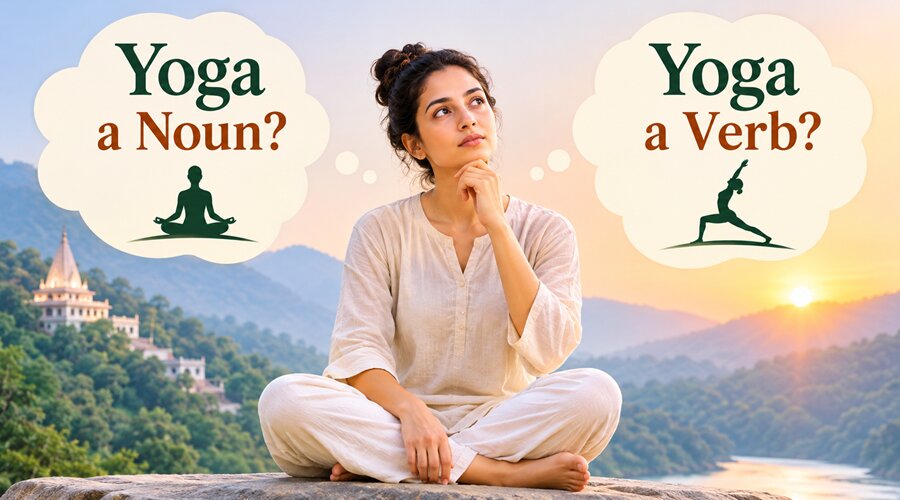
Is Yoga something you do or something that happens when your attention comes together?
The first step in understanding Yoga may be to examine the word itself.
Most of us treat Yoga as a noun, something we practise for an hour in the morning, learn in a classroom or perform on a mat. We say, “I do Yoga,” much as we say, “I play football” or “I study mathematics.” The word becomes the name of an activity, something we can schedule, learn and complete.
But what if we look beyond the word and examine what happens during the practice?
Although Yoga is grammatically a noun, we can understand it as a process rather than an object. The Sanskrit root yuj is commonly associated with joining, yoking or uniting. From this perspective, Yoga is not merely something to possess or perform. It is something to investigate as it unfolds.
Consider the difference between love and loving. Love can be defined, discussed and understood as an idea. Loving, however, is expressed through what happens from moment to moment. The word points towards something, the process brings it into life.
Something similar can be explored through Yoga. Rather than limiting our understanding to a concept, we can investigate the process of attention gathering and the relationship between the mind and what holds its attention.
When Attention Comes Together
You may have experienced this without ever calling it Yoga.
A musician becomes absorbed in a piece of music. A scientist gives complete attention to a difficult problem. An artist becomes so involved in creating that the surrounding room seems to disappear. A child plays without constantly thinking about how others perceive them.
In such moments, attention is no longer scattered across countless unrelated concerns. It gathers around what is happening.
Yet an important question remains, is absorption alone Yoga or does Yoga invite us to understand the mind and the nature of attention more deeply?
This distinction matters. Being absorbed in a task may be a moment of concentration but Yoga, as an inquiry, asks us to examine how attention moves, what disturbs it and what allows it to become steady.
We begin to look beyond the experience itself and investigate the mind that experiences it.
What Are You United With?
There is another question hidden within this exploration, at any given moment, what is occupying and directing your attention?
You may be sitting quietly while your mind is occupied by an argument from yesterday. You may be listening to someone while mentally preparing your reply. You may be practising a posture while worrying about how it looks.
The body may be in one place while the mind is elsewhere.
At other times, your attention may be fully engaged in listening, observing or understanding. The difference is not necessarily in the activity itself but in the relationship between your attention and what you are doing.
This invites us to ask, what is my mind occupied with right now?
Fear or understanding? Desire or contentment? Conflict or clarity? Habitual distraction or attentive observation?
These are not simply opposing states to label as good or bad. They are possibilities to investigate. What draws the mind towards them? How do they influence our perceptions, decisions and actions? Can we understand their movement rather than merely react to it?
The quality of our lives is shaped, in part by these repeated movements of attention.
From Practice to Understanding
Seen this way, Yoga extends beyond postures, breathing exercises and meditation techniques. These practices matter because they provide opportunities to observe the body, breath, attention, thoughts and reactions.
But the performance of a practice is not the same as understanding what it reveals.
We may perform a posture perfectly and remain unaware of the impatience it brings to the surface. We may sit in meditation and continue to be carried away by habitual thoughts. Repetition can develop skill but understanding requires inquiry.
This is where practice and philosophy meet. Practice provides the experience, inquiry examines it, discernment helps us distinguish what we understand from what we merely assume.
At Rishikesh Vidyapeeth, this exploration leads towards “Vidya” or understanding that goes beyond the accumulation of information. The aim is not simply to make the mind concentrate but to investigate how it functions and to understand the forces that shape our experience.
The postures, breath, ethical principles, concentration and meditation are not merely separate items on a list. They can be explored as interconnected aspects of a larger process of understanding.
So perhaps “Do I practise Yoga?” is only the beginning of the inquiry.
A deeper question is, what is my mind occupied with right now, and do I understand what is happening?
That is where our exploration of Yoga begins.